The Complete Guide to CPVC Pipes and Fittings: Performance, Types, and Applications
In modern plumbing, industrial processing, and fire protection systems, CPVC pipes and fittings have established themselves as a premium solution for demanding fluid handling applications. Chlorinated Polyvinyl Chloride (C-PVC) offers distinct advantages over traditional materials, combining high temperature resistance with exceptional durability and corrosion protection.
Understanding the full range of CPVC piping systems helps engineers, contractors, and facility managers select optimal components for residential, commercial, and industrial projects.
What Are CPVC Pipes and Fittings?
CPVC Pipes and Fittings
CPVC pipes and fittings are thermoplastic components manufactured from chlorinated polyvinyl chloride resin. This material is produced by chlorinating PVC resin, which increases the chlorine content from approximately 57% to 63-69%. This additional chlorination significantly enhances the material’s properties, raising the maximum service temperature and improving chemical resistance.
The result is a piping material that combines the ease of installation associated with plastics with the thermal performance required for hot water and industrial applications. CPVC pipe fittings are available in various configurations and pressure ratings to suit diverse system requirements.
Key Advantages of CPVC Piping Systems
1. Superior Temperature Resistance
The most significant advantage of C-PVC pipes is their ability to handle elevated temperatures. While standard PVC is limited to 60°C (140°F), CPVC pipes and fittings can operate continuously at temperatures up to 93°C (200°F) for short durations and 82°C for long-term service. This makes CPVC plumbing ideal for hot water distribution, industrial process lines, and heating applications.
2. Exceptional Corrosion Resistance
Unlike metal piping systems, CPVC fittings do not rust, corrode, or scale when exposed to aggressive water conditions. CPVC is 100 percent immune to degradation or corrosion from chlorine, chloramines, and chlorine dioxide commonly found in drinking water. This immunity eliminates a key cause of premature failure seen in copper and PEX systems .
3. Chemical Compatibility
CPVC pipe offers excellent resistance to a wide range of industrial chemicals, including acids, bases, and salts at elevated temperatures. It performs well with sulfuric acid (below 70%), hydrochloric acid (below 35%), and sodium hypochlorite (below 12.5%). However, CPVC is not suitable for aromatic hydrocarbons, ketones, or chlorinated solvents.
4. Pressure Retention at Temperature
CPVC pipes and fittings maintain significant pressure capacity at elevated temperatures. While deration applies as temperature increases, CPVC retains useful pressure ratings up to its maximum service temperature, unlike PVC which becomes unusable above 60°C.
5. Hygienic and Safe
CPVC pipe fittings are manufactured without harmful additives, keeping water clean and safe for drinking applications. The material has low biofilm-formation potential, contributing to water quality preservation.
6. Fire Resistance
C-PVC is inherently self-extinguishing, adding an extra layer of safety in concealed installations. This property makes CPVC fire sprinkler systems a popular choice under NFPA 13 requirements.
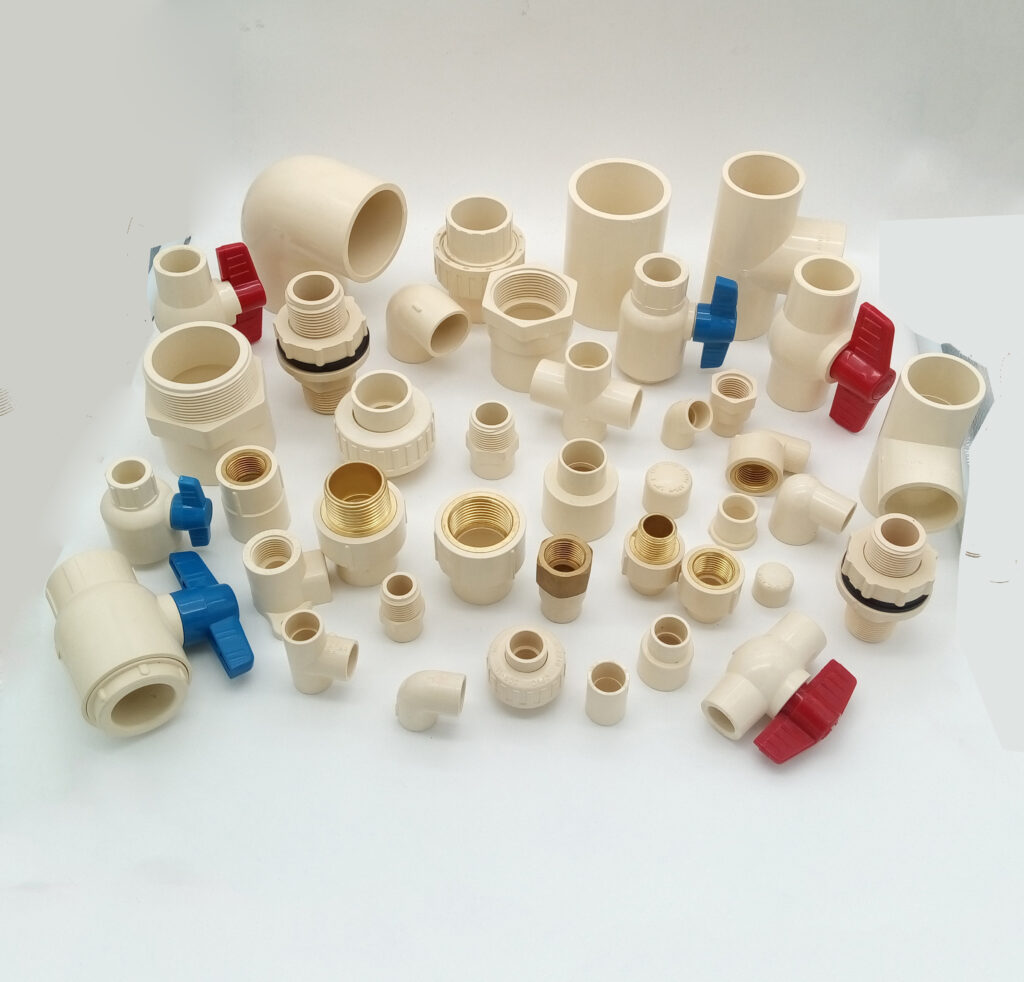
Common Types of CPVC Fittings
Understanding the different types of fittings and connectors for CPVC pipes is essential for proper system design.
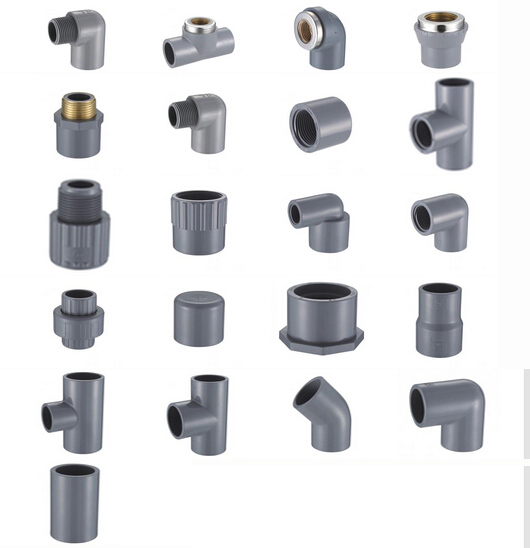
Elbow Fittings
CPVC elbow fittings change the direction of water flow through the piping system. Common configurations include:
90° Elbow: Creates a sharp turn for tight spaces
45° Bend: Provides a smoother directional change, reducing friction and maintaining better flow
Reducer Elbow 90°: Turns the pipe while reducing its size
Tee Fittings
Tee fittings are crucial for branching from a main waterline to supply additional outlets:
Straight Tee (Tee 90°): Connects three pipes of the same size, allowing flow in multiple directions
Reducing Tee: Used when the branch pipe differs in size from the main pipe
Cross Tee 90°: Distributes flow in multiple directions from a single point
Couplings and Unions
CPVC couplings join two sections of pipe together:
Standard Couplings (Register Couplings): Connect pipes of the same diameter for permanent, aligned joints
Reducing Couplings: Connect pipes of different diameters
Repair Couplings (Slip Couplings): Feature extended sockets without central stops, allowing the coupling to slide along the pipe for efficient repair without system shutdown
Union Fittings: Enable easy disconnection and reconnection of pipes for maintenance
Adapters and Transition Fittings
Adapters are essential when connecting CPVC to other materials or different fitting types:
Male and Female Adapters: Connect threaded fittings to CPVC pipes
Transition Bushings: Provide smooth transition between CPVC and other plastic pipes
Reducer MTA/FTA: Reduce pipe size while offering male or female threaded connections
Brass CPVC Fittings: Provide durable metal-to-plastic connections for added strength at equipment connections
Caps and Plugs
When system sections need sealing:
End Caps: Placed over pipe ends to completely close them off
Threaded End Plugs: Temporarily close off threaded CPVC brass fittings
Valves and Specialized Fittings
Ball Valves: Control flow with simple quarter-turn operation
Non-Return Valves (NRVs): Allow water flow in only one direction, preventing backflow
Reducers: Connect CPVC pipes of different sizes, available in concentric configurations
Step-Over Bend: Helps bypass obstacles by raising the pipeline over them
Standards and Specifications
Quality CPVC pipe fittings must meet rigorous industry standards to ensure safety and performance.
Material and Dimensional Standards
ASTM F441: Covers CPVC pipe, Schedule 40/80
ASTM F442: Addresses CPVC pipe, SDR-PR
ASTM D2846: Specifies CPVC for hot/cold water distribution
ASTM F437: Covers threaded Schedule 80 CPVC plastic pipe fittings, including requirements for materials, workmanship, dimensions, and burst pressure for elbows, tees, crosses, couplings, plugs, and caps
ASTM F438: Specifies Schedule 40 socket-type CPVC pipe fittings for use with Iron Pipe Size (IPS) plastic pipe in pressurized liquid distribution
ASTM F439: Addresses Schedule 80 CPVC fittings for hot and cold water systems
EN ISO 15493: Covers plastics for industrial applications
Pressure Ratings and Schedules
CPVC fittings are commonly available in:
Schedule 40: Standard wall thickness for general applications
Schedule 80: Thicker wall for higher pressure requirements
SDR ratings: Standard Dimension Ratio configurations for specific pressure classes
Installation Best Practices
Proper installation is essential for maximizing CPVC plumbing performance.
Solvent Welding Process
CPVC pipes and fittings are joined using solvent welding, which creates a strong chemical bond between the pipe and fitting. This process chemically fuses the components into a single piece that is stronger at the fitting than the pipe alone.
Key practices include:
Test fit before applying solvent cement—proper interference fit ensures resistance before welding
Apply heavy, even coat to pipe end, then thin coat inside fitting socket
Weld each joint as it is assembled—never pre-assemble and come back
Use CPVC-specific solvent cement (primer may be required for Schedule 80)
Transition Between CTS and IPS Systems
Residential projects may use IPS Schedule 80 CPVC for mains and risers larger than 2 inches, transitioning to CTS piping for fixture distribution. This requires transition fittings or bushings specifically designed to connect IPS to CTS pipes.
CPVC vs. PVC: Key Differences
While related, CPVC pipe fittings differ significantly from PVC:
Property
PVC
CPVC
Chlorine Content
~57%
63-69%
Max Service Temperature
60°C (140°F)
93°C (200°F)
Tensile Strength
48-55 MPa
55-62 MPa
Color
White, gray
Light gray, off-white/ivory
Applications
Cold water, drainage
Hot/cold water, industrial
Relative Cost
1.0x
1.5-2.0x
Applications Across Industries
CPVC pipes and fittings serve critical functions across numerous sectors:
Residential Plumbing
Hot and cold water distribution in homes, apartments, and hotels. CTS SDR 11 CPVC (tan) is commonly used for mains and partition piping.
Commercial and Multistory Buildings
IPS Schedule 80 CPVC (gray) serves risers and mains in larger projects, apartments, dorms, and hotels.
Industrial Processing
Chemical transport, acids, bases, and salts at elevated temperatures.
Fire Sprinkler Systems
Listed CPVC systems per NFPA 13 provide reliable fire protection.
Hot Water Recirculation Loops
CPVC maintains integrity in continuous hot water circulation.
Performance Characteristics
CPVC pipe fittings deliver reliable performance under demanding conditions:
Service Life: Over 50 years under normal design and operational conditions
Temperature Range: Suitable for continuous operation up to 90°C
Pressure Deration: Pressure capacity reduces with temperature according to published factors
Why CPVC Stands Apart
CPVC plumbing systems offer unique advantages over alternatives:
Complete immunity to chlorine degradation—unlike PEX and copper, which can fail prematurely in aggressive water conditions
Socket-style fittings minimize pressure drop compared to PEX insert fittings
Proven reliability since 1959—the only system capable of standing up to the full range of aggressive water conditions found in the U.S. and Canada
Conclusion
CPVC pipes and fittings represent a proven, reliable solution for hot and cold water distribution, industrial processing, and fire protection applications. Their unique combination of high temperature resistance, corrosion immunity, chemical compatibility, and long-term durability makes them indispensable in residential, commercial, and industrial systems.
By understanding the complete range of CPVC fittings available—from basic elbows and tees to specialized transition fittings and valves—engineers and installers can select optimal components for any requirement. When specified according to appropriate standards and installed correctly with proper solvent welding techniques, CPVC piping systems deliver decades of reliable service.
Whether you’re designing a residential plumbing system, outfitting an industrial processing plant, or installing fire protection infrastructure, C-PVC pipes and fittings provide the performance, reliability, and value that professional applications demand.